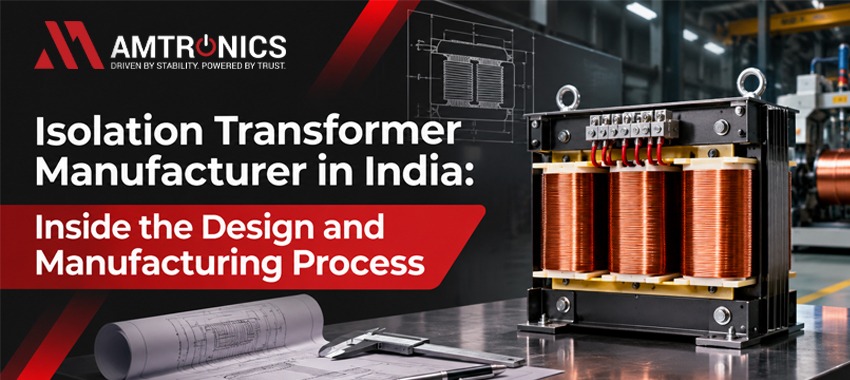
Isolation Transformer Manufacturer in India: Inside the Design and Manufacturing Process
However, electrical equipment requires an appropriate power source for consistent operation. Electrical noise or unwanted electrical connections can disrupt equipment in factories, laboratories, hospitals and commercial building. An isolation transformer isolated the supply of power through magnetic induction while maintaining the input and output circuits electrically isolated, so insulation and construction of the transformer is a key factor in electrical isolation.
The connected load, electrical ratings and materials used, as well as the environmental conditions of installation are factors an Isolation Transformer Manufacturer in India will take into account prior to the development of the equipment. The manufacturing stage integrates the magnetic core, the primary and secondary windings, the insulation as well as the enclosure.
How an Isolation Transformer Works
An isolation transformer consists of a primary and secondary winding. The primary winding is fed from the supply and the secondary provides power to the load. The energy can flow through the magnetic field in the core, but there is no direct conductor connection between the two winding.
This isolation is known as galvanic isolation. It can help to reduce the flow of some electrical noise between the power supply and the load. The actual effectiveness varies according to design, winding layout, shielding and installation.
A knowledgeable Isolation Transformer Manufacturer in India should match the transformer construction to the application's requirements rather than assume that every model offers the same level of noise reduction.
Choosing the Core Material
A magnetic core guides the magnetic flux generated in the primary winding. The core material and construction determine the losses, temperature, size and performance.
CRGO (cold-rolled grain oriented). The core is assembled out of thin, insulated laminations. This limits the eddy-current losses that could otherwise lead to additional heat production.
The core dimensions and lamination configuration is determined by voltage, frequency, power rating and design constraints. Correct assembly is essential as loose joints or damaged laminations will impact performance.
Good Isolation Transformer Manufacturer in India takes into account what kind of material and core should be used to assemble the isolation transformer.
Primary and Secondary Winding Construction
Windings flow current and produce the magnetic field within which power is transferred. They are normally made of copper or aluminium conductors, depending on the configuration and the requirements.
The primary winding is connected to the input supply and the secondary is wound to give the desired output. The turns ratio and conductor size are determined by the voltage ratio, current, frequency and temperature limits. Insulation must be maintained between the turns and layers of the winding.
Winding should be done carefully in order to produce the intended electrical performance and operation. The lead length and therefore the between the primary and secondary windings is also one of the elements of isolation, which helps in the total failure of the transformers assembly.
Galvanic Isolation and Electrostatic Shielding
The input and output circuits have no direct conductive path between them. This may be desirable where the equipment needs to be electrically separated from the supply circuit for operational or safety reasons.
Others may have an electrostatic screen placed between the windings. This is a conductive layer that is connected to earth as defined by the design. It can reduce the effects of capacitive coupling and can shunt some common-mode electrical noise, but works only if correctly manufactured, earthed and installed.
An Isolation Transformer Manufacturer in India must reveal if the item has a shroud as well as what it is made to accomplish. The shroud will certainly not be secure versus all sorts of power surges, transient or power quality related issue, so there are various other safety tools that may be needed on some installations.
Insulation & Thermal Design
Insulation insulates various conductive parts of an electrical system to prevent accidental contact. The various types of electrical insulation are assigned according to the voltage stress, temperature, environment in which it is operated, and the design considerations.
Losses (core and winding) give rise to heat during operation. The transformer has to be capable of controlling this heat to within design specifications. The conductor size and core design, ventilation, arrangement of the enclosure, and cooling method are factors which determine temperature rise.
Air-cool sections: Sufficient space should be allowed for air circulation and ventilation openings should not be obstructed. A reliable Isolation Transformer Manufacturer in India takes into account the nature of the operation to be performed before deciding the insulation and cooling system.
Single-Phase and Three-Phase Configurations
Isolation transformers can be purchased for single-phase and three-phase electrical supplies. They should be selected based on the system powering the load and the electrical supply.
Single phase units are suitable for some types of electronic equipment, laboratory equipment, and smaller loads. Three phase units are suitable when used with equipment or the distribution system that requires three-phase power.
Please ensure the input/output volts, kVA rating and connection type are checked before ordering. The Isolation Transformer Manufacturer in India will not quote capacity based on a machine name but instead the above information.
Also check the connected load, starting characteristics, duty cycle and conditions of operation. The right sizing will prevent overloadings and also will help in the intended performance.
Inspection and Electrical Testing for Manufacturing
Quality checks ensure that the transformer has been constructed in accordance with the design. Checks can include; the core, winding connections, insulation, terminals, enclosure and nameplate data.
Depending on the product and specification, electrical tests may include:
-
Winding resistance testing: Measures the electrical resistance of the windings.
-
Turns ratio testing: Confirms the turns ratio of the primary and secondary windings.
-
Insulation resistance testing: Measures the insulation condition among electrical parts.
-
Dielectric testing: This measures the resistance to an electric current using a controlled test.
-
Connection testing: Check for the polarity and phases where relevant.
Production tests: tests in accordance with design test or customer agreement. The results of the tests should be filed for comparison with the design values.
Buyers should ask which tests are standard and if test reports are available from their Isolation Transformer Manufacturer in India.
Uses of Isolation Transformers
Isolation transformer is used where electrical separation is required. Some of its applications are as follows:
-
Industrial control equipment and automation systems.
-
CNC machinery and manufacturing equipment.
-
Printing and packaging machines.
-
Laboratory instruments and testing equipment.
-
Communication and data equipment.
-
Selected medical and electronic installations.
The transformer applied should be suitable for the equipment and electrical system. Since a sensitive control system might have different needs from large machine, voltage, phase, load, earthing arrangement and working environment have to be considered to choose a suitable unit.
A reputed Isolation Transformer Manufacturer in India will take these details into consideration once the customer provides the load and installation details.
Never assume that an isolation transformer offer any of these features: not automatic voltage regulation or backup power source and not free from all electrical faults. Additional equipment may be needed for specific applications.
Things to verify before choosing the correct manufacturer
When choosing the most appropriate supplier you need to evaluate the following details in addition to the quoted price. Factors to consider should include the technical datasheet, rated capacity, input and output voltage, winding details, core and insulation details.
In addition, ask if they have standard or custom ratings, what conditions are best suited for installation, and what warranty and service support can be offered.
Any reputable Isolation Transformer Manufacturer in India will be able to explain the design and assist to confirm that the unit you have selected is right for the application. Never buy based on technical specifications prior to purchase, incorrect capacity selection and erroneous installation problems.
Isolation Transformer Solutions
Amtronics provides options of ultra-isolation transformers with the CRGO cores and electrolytic copper windings with electrostatic shielding. The products range of Amtronics also comprises single phase and three-phase transformer variations as well as with capacity customization.
Customers can review the available specifications and share their voltage, phase, kVA rating and application requirements to discuss a suitable configuration.
For businesses comparing an Isolation Transformer Manufacturer in India, the important step is to match the transformer design with the actual electrical requirements. A correctly specified and properly installed unit can provide the intended electrical separation and support dependable operation of connected equipment.