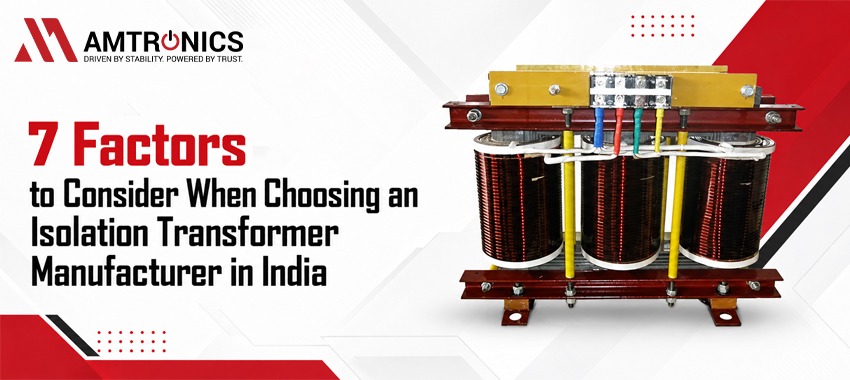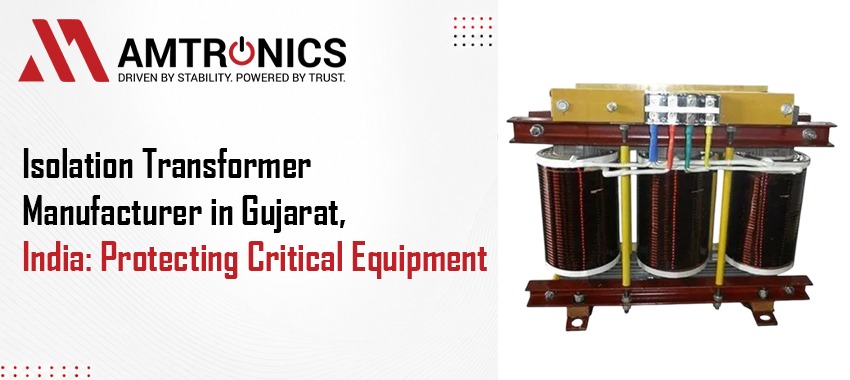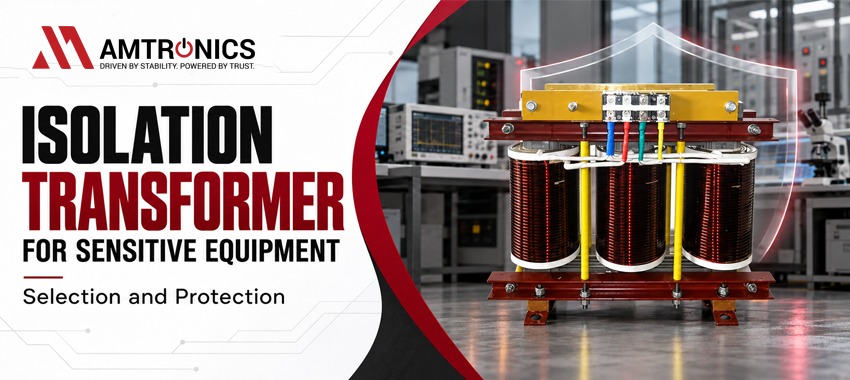
Today's industrial plants use sensitive electrical equipment for accuracy, efficiency, and stable operating conditions. CNC machines, laboratory instruments, automation systems, and electronic panels are vulnerable to electrical noise, ground-looping, and power issues. Using the right isolation transformer can resolve some of these problems, or help provide better power quality for equipment that demands a cleaner power supply.
A knowledgeable isolation transformer manufacturer can guide you through the process of assessing your company's power needs and selecting the best transformer arrangement for your application. Learn what isolation does, where it's applicable, and which criteria are significant to industrial buyers.
1. Isolation Transformer Function
The isolation transformer transfers an electric energy between two windings. An electrical galvanic isolation is achieved there.
This isolation can help break some of the conductive paths through which electrical noise propagates and eliminate some ground-loop issues if the installation is properly designed. Other isolation transformers may incorporate electrostatic shielding between the windings to minimize capacitive coupling of electrical noise.
But an ordinary isolation transformer cannot automatically regulate the voltage, block all surges and correct all power-quality problems. An isolation transformer manufacturer should be able to disclose details about the transformer's construction and shielding, electrical ratings and application.
2. Uses of Isolation Transformers
Isolation transformers are also used in various settings where electrical isolation and power quality are important.
CNC machines and industrial automation: Any CNC machinery, programmable logic controllers, and production equipment contain electronic parts that may be vulnerable to power fluctuations. Isolation can be achieved on suitable equipment with an appropriately rated transformer.
Test and measurement equipment: Measurement and test equipment and their associated power systems will necessitate a meticulous design to ensure safety, accuracy and minimisation of unwanted electrical noise.
Medical and electronic equipment: Depending on their electrical design, some specific systems need isolation. For medical installations, there are specific safety standards and equipment requirements.
IT and communication systems: Isolated can be applied to some communications and electronic systems if the presence of earthing arrangements or electrical noise causes significant problems.
Let the seller know what piece of equipment is to be powered, how sensitive it is electrically, and the issue to be solved by installing the transformer. These factors help decide whether an isolation transformer manufacturer is suitable or whether a power-quality solution is needed.
3. Important Features Buyers Should Evaluate
Although the size of the transformer and the rating of the capacity is a good starting point, there are other factors to consider.
KVA rating: The transformer needs to be able to handle the load that is connected to it under normal working conditions. Take into account the total load, power factor, duty cycle and equipment with high start-up currents.
Supply and output voltages: check the input supply voltage, power output voltage, phase and frequency. The ratio of the transformer should correspond to the electrical load.
Electrostatic shielding: Shielding can help to minimize the capacitive coupling of electrical noise between the windings. The effectiveness is dependent upon design and proper grounding.
Thermal stress and temperature increase: thermal performance is dependent on the insulation class and the cooling system used, the ambient temperature and the anticipated loading.
Test reports: Where required, review relevant test reports, construction documentation and test papers relating to the proposed installation.
A technically capable isolation transformer manufacturer should be able to describe these specifications and guide the purchaser in relation to each individual model rather than wide product claims.
4. Select an Isolation Transformer that Meets your Equipment Needs
No two factories are alike when it comes to electricity. When it comes to choosing the right transformer, first you need to know your machinery and your power supply.
First, note the connected load and whether multiple machines will be running concurrently. Consider starting currents for motors, electronic power supplies, and other loads, all of which can affect the size of the transformer.
Next, identify the incoming voltage and the required output voltage. Also ask if the installation is single-phase or three-phase and if the equipment needs a specific ground set-up.
The environment of operation must also be taken into account. Temperature, dust, ventilation, space needed for install, maintenance etc.
An isolation transformer manufacturer will use this information to assist recommend the ratings and configuration. It is also worthwhile to look into the electrical issue in the first place as it might be caused by other factors such as voltage fluctuation, harmonic, surge and electrical noise.
Check at time of purchase that the transformer is suitable for the equipment manufacturer's specifications and the appropriate installation requirements.
5. Selecting a Quality Isolation Transformer Manufacturer
The process of choosing a supplier is one of the steps involved with the purchasing of industrial electrical equipment. When selecting a manufacturer for buying your electrical equipment, do not just go on the product price. Instead look at the technical capabilities of the manufacturer, the documentation and support they provide.
Technical expertise: The vendor has a level of knowledge about load needs, ratios, winding arrangements, shielding, and installation circumstances.
Customisation options: Some applications need particular input/output voltages, special enclosure arrangements or specific shielding arrangements. Check which options are available for the model you require.
Quality and Testing: Inquire about the production process, types of insulation used, electrical testing carried out and related documentation.
Support resources: well-defined warranty information, instructions for installation and maintenance, and technical support. These resources can help businesses maximize the service life of their equipment.
If comparing isolation transformer manufacturer, ask for specification that are relevant to your application. Supplier comparison becomes more useful when comparing equivalent ratings and features.
6. Isolation Transformers from Amtronics
Amtronics is a transformer manufacturer from Ahmedabad, Gujarat that supplies both commercial and industrial transformers. Companies interested in an isolation transformer may examine the product details listed here to see the different specifications that may be available and if a certain specification would work for their machinery.
You can be considered an Amtronics isolation transformer seller when selecting a purchase, knowing that it is a safe and effective device for electrical isolation needs. Check the chosen device for it rated capacity, ratio of voltages, winding style and amounts of shielding.
Provide information about the equipment connected to the generator, input supply, output desired, and environment of use when asking for technical advice.
Visit the Amtronics Ultra Isolation Transformer product page for product information and more details.
7. Frequently Asked Questions
What is the main purpose of an isolation transformer?
It is mainly used to electrically isolate two circuits from each other. In addition, it can also be used to eliminate some electrical noise and ground-loop problems, depending on the configuration and installation.
How should I choose the right capacity of the transformer?
Consider the total connected load, power factor, starting conditions, expected operation time, and future growth. An isolation transformer manufacturer or licensed electrical contractor can assist in selecting the appropriate rating.
Can an isolation transformer keep equipment safe from all electrical anomalies?
No. It isn't a silver bullet that automatically compensates for voltage fluctuations, filters out all surges, or solves every harmonic or ground problem. No one size fits all answers. Match the solution to the problem.
Conclusion
When considering an isolation transformer, take into account the load capability, the voltage needed, the type of shielding and insulation, and the environment in which the equipment is installed. Determine the problem before shopping for equipment. Ensure the equipment is able to power the load.
By assisting a buyer in assessing different options, an industry expert in isolation transformer production can guide them to the ideal isolation solution for their specific power isolation needs.